
A friend shared a graphic circulating on LinkedIn that claims to explain “Leadership Balance Under Pressure.” They inquired whether the advice or approach is any good, or if it was what I like to call “pop-leadership.” That’s a great question. For clarity, the graphic features four animals arranged in a 2×2 quadrant. High assertiveness with low compassion makes you a Shark, fast and results-focused. High assertiveness with high compassion makes you an Elephant, calm and protective. Low assertiveness with low compassion makes you a Turtle, withdrawn and conflict-avoidant. And low assertiveness with high compassion makes you a Panda, warm and tension-avoiding. Of course, another animal is missing, but we’ll get to that later.
Indeed, the graphic is simple. It’s easy to follow. The intention is good. In fact, it probably feels about right on the surface. But is it accurate? Take a look at the following graphic and reflect critically on what it suggests.
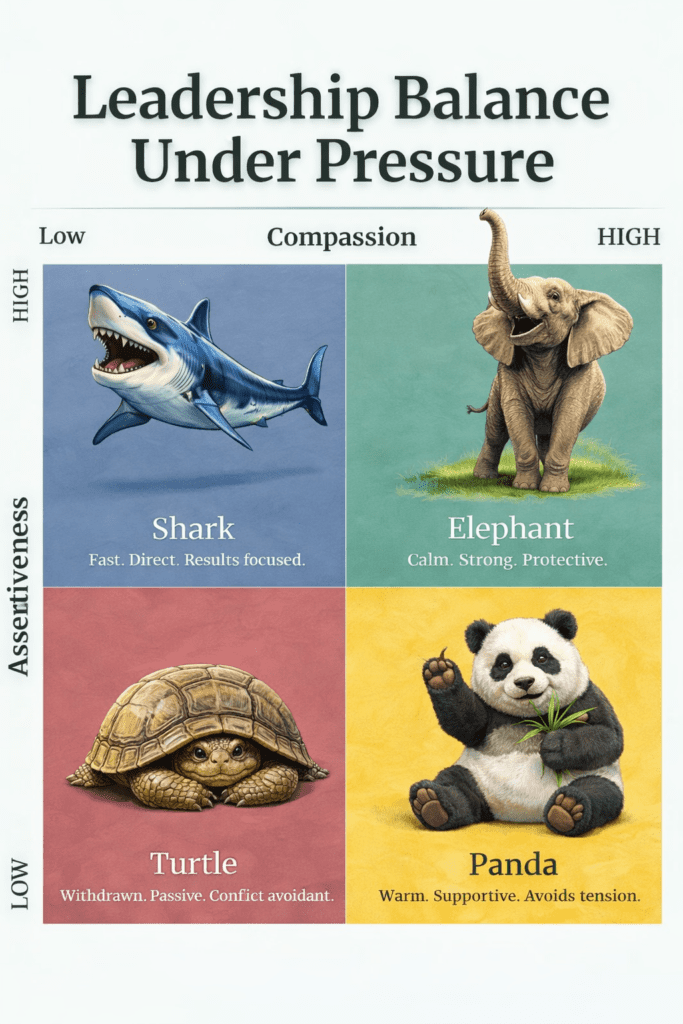
If you do the research, you will see that the social proof is there. Thousands of people have shared it. Professionals have nodded along. Leaders have probably forwarded it to their teams. However, from a “science of leadership” standpoint, the reality is that nearly every conceptual choice embedded in that graphic is fundamentally wrong. In fact, I might go so far as to say it is dangerous.
Now, this is not a minor critique of a well-intentioned simplification. The problems with this model cut to the core of why leadership development has remained a field of recycled metaphors and retreating effectiveness for decades. Understanding exactly what is broken in a graphic like this is not pedantry. It is literally the difference between a discipline and a hobby. If you’re serious about leadership, then what I am about to say matters. So, let’s dig in.
The Quadrant Is the First Lie
The 2×2 matrix is one of the most seductive and epistemically dishonest formats in organizational content. It takes continuous, contextually modulated human behavior and carves it into four static boxes. Once you name the boxes and assign them memorable labels, the model feels complete, but complete, it is not. If anything, it is a taxonomy masquerading as a theory. Naming something is not explaining it, and categorizing behavior is not the same as understanding it.
This is Epistemic Rigidity Theory in action. The graphic works precisely because it simultaneously activates confirmation bias and the Einstellung effect. Readers pattern-match to a familiar animal, feel momentarily recognized, and stop interrogating whether the underlying framework has any causal power. Well, it absolutely does not. There is no mechanism in this model, no upstream architecture, no explanation of why someone occupies one quadrant or how they might move to another. The animals are the end of the analysis, not the beginning. Worse yet, the selection is made by those who want to be in a specific quadrant, not necessarily where they might truly fall. There is actually very little value here.
The Axes Are Not What They Claim to Be
This next point really gets under my skin. The graphic plots “assertiveness” on one axis and “compassion” on the other, treating them as independent, orthogonal dimensions. This is empirically inaccurate and dangerous. Both assertiveness and compassion are actually regulated by overlapping neurobiological systems that involve threat appraisal, autonomic arousal, and attachment circuitry. They are not clean or separable variables that can be independently dialed up or down. I would argue that presenting them as such actually embeds a false model of human psychology at the framework’s structural foundation before any content is introduced. Moreover, even trying to adhere to these would likely result in learned helplessness, failure, and abandonment of effort.
Of course, the title compounds the problem. “Leadership Balance Under Pressure” places pressure at the center of the model without defining it once. What are we talking about here? Pressure from time scarcity, moral conflict, physical threat, interpersonal betrayal, and resource competition produces fundamentally different neurological and behavioral profiles. Collapsing all of that into a single implied condition and then assigning animal metaphors to the outputs is not a framework. It is a label generator that means very little.
The 3B Model Reveals What This Graphic Misses
Let’s use the 3B Behavior Modification Model as a diagnostic tool. The quadrant graphic makes the most common error in behavioral science applied to leadership: it starts at the terminal output and calls it a model. The 3B framework establishes that Emotion drives Bias, Bias drives Belief, Belief drives Behavior, and Behavior drives Outcomes. Well, what you see in a 2×2 quadrant is the behavior column, at best. For example, the Shark is not a leadership style. It is the observable output of a specific emotional state, which activates specific biases and produces specific beliefs about what action is warranted in a given context.
To actually understand and develop leadership behavior, you have to work upstream. The question is not whether someone presents as a Shark or an Elephant. The question is: what emotional architecture produces that behavioral pattern, what biases operate beneath the surface, and what beliefs about authority, safety, performance, and relationships those biases have generated over time. This quadrant graphic cannot answer any of those questions. It doesn’t even do a good job of describing the surface, leaving every practitioner without a lever to pull.
The Normative Bias Hidden in the Design
Objectively, the Elephant is positioned as the implicit ideal. Calm, strong, protective. Indeed, those descriptors carry obvious positive valence. The Shark is subtly framed as a problem to be corrected, even though a high-assertiveness, low-compassion profile is frequently the most adaptive in genuine crisis leadership, military command, emergency triage, and rapid-decision environments where deliberation has a cost measured in real outcomes. Doesn’t context determine behavioral fitness? This model ignores context entirely and encodes a normative judgment into what is presented as a descriptive tool. That is bias and idealism presented as science, and it must be terribly confusing for those who try to adhere to it.
Why This Keeps Spreading
The problem is that this graphic is visually clean, emotionally resonant, and shareable in twelve seconds. That’s great for social media, where nonsense is easily and rapidly shared, but this is not a compliment. It spreads for the same reason horoscopes spread: the categories are broad enough that most readers will find themselves in one (or two) of them without significant distortion, and the act of recognition feels like insight. But that is precisely the problem: it is not insight at all. It’s not even actionable. If anything, it is the Dunning-Kruger effect wearing a leadership badge.
Worse yet, a person who shares this graphic likely feels they have communicated something meaningful about themselves or leadership development in general. In reality, the only thing they have truly communicated is a meaningful insight into how confirmation bias works. More often than not, they will share it along with a brief statement about what or why they THINK they are whatever animal they chose, or perhaps what animal to avoid. The bigger danger here is that they have attached their identity to it, which will make it even harder to make corrections or achieve accuracy.
In many ways, this is the Novice Factor operating at scale. When leadership development is dominated by content that is accessible, shareable, and mechanistically empty, the field trains practitioners to recognize patterns rather than understand systems. Leaders learn to identify Sharks and Pandas in their organizations without developing the capacity to address the emotional and cognitive architecture that generates those behaviors. The result is a field that feels busy and looks productive, yet produces little lasting change in the organizations it serves, and this typically leads to stagnation, decline, and failure. Ironically, in high-stakes or high-pressure settings, old behavior resurfaces because a genuine understanding or correction was never achieved.
What a Real Model Does
A mechanistically sound leadership framework does not describe behavior. It explains the conditions that produce behavior, provides an intervention architecture that targets those conditions, and generates testable predictions about what changes when inputs are altered. Reasoned Leadership frameworks, including Epistemic Rigidity Theory, the 3B Model, and Adversity Nexus Theory, are built to do exactly that. They are not animal metaphors. They are theoretical structures with causal logic, upstream intervention points, and developmental pathways that account for the neurobiological and cognitive architecture of behavior change.
I’ll just be blunt and say that you are not an elephant, and you are not a shark. You are a human being. The animal metaphor invites you to pick one of four animals and see yourself inside the chart. However, the moment you accept that premise, you have already accepted the classification system that produced it. At that point, you are no longer one of the animals in the grid.
Yes, there is another animal that sits just outside of this grid that wasn’t shown in the chart. It’s called a Sheep. It’s the one being easily led into the pen. Understand that the framework does not simply describe behavior. It conditions people to accept the categories it provides. Anyone who adopts the labels without questioning the assumptions is demonstrating the very behavior the Sheep metaphor represents.
If you’re serious about leadership, then the real question is not which animal you are. The real question is why anyone accepted such nonsense in the first place. Accuracy is the difference between a field that produces temporary awareness and a discipline that produces durable change. Pop-leadership content like the quadrant graphic does not just fail to help; it actively harms by crowding out more rigorous frameworks with something that only resembles them. I’m sorry to say, but that has consequences for every leader who shares it and every organization that builds development programs around it.
On a more accurate note, here’s a little advice. A turtle will bite you; an elephant will crush you when angered; sharks generally avoid people; and the panda is a solitary, dangerous bear capable of severe aggression. The metaphor is wrong in almost every direction. I’ll get off the soapbox and close with a remark about the framing of the Shark. In leadership terms, the Shark is sometimes very necessary. If you see it as “bad,” then understand it is merely a symptom. However, no one has ever solved a symptom by naming it after a dangerous animal and then leaving people to guess how to fix it.
If you’re ready for leadership built for serious humans, then let’s have a conversation or simply continue reading my articles. There is so much more to learn.
Learn More: